Tuesday, March 15, 2011

Why Nuclear Doesn't Make Sense

Anyone watching what is happening in Japan right now should have a pretty good idea why I'm writing this post.  But you're wrong.  As is pointed out here and here, the problem with nuclear is not that it could (will) blow up.  It's not even that the waste sticks around for 100,000 years and needs to be stored somewhere for that long (think about how well we understand the language from 10,000 years ago and you begin to see why that's a problem).  It is simply the cost. 

As is pointed out in the FP article above, the industry can overcome the danger of explosions.  New reactors are far safer than even the ones in Japan.  With some revision to current standards and a bit of beefed up protection, nuclear is relatively safe.  But therein lies the problem and the author of the FP piece never really addresses it.  Nuclear is not viable under current permitting regimes unless it is given huge subsidies.  It is an outrageously expensive source of power.  The new requirements that will come out the disaster in Japan will do nothing to make it less expensive.  

This is the real problem with nuclear.  It isn't fall out, it isn't explosions, it isn't radioactive waste.  It's basic economics.  Nuclear is more expensive than any other available power source when compared on a non-subsidized basis.  So why, when it has a litany of other problems, should we continue to subsidize it?  That money is better spent on research, efficiency programs and subsidies for non-nuclear renewables. 

Monday, March 14, 2011

Erlich's Equation

Paul Erlich may be the most famous population economist.  Of the malthusian school he famously wrote "The Population Bomb" in the 1970s and, then just as famously, had to eat his words in the 1990s.  That his projections were incorrect at the time do not reduce the relevance of some of his work however.  Specifically, in light of the preceding post, I'd like to focus on his equation for environmental impact.  

Elegant and simple, he claims that environmental impact is directly related to affluence, population and some technology factor that moderates the impact of population and affluence.  It looks like this: 

I = A x P x T

 Where I is environmental impact, A is affluence, P is population and T is the technology factor.  While the relationship can be displayed in greater complexity, this equation captures the heart of the issue. 

I bring it up here, because drawing on numbers from the "Prosperity without Growth" Report, it gives a very good mathematical illustration of why technological change is not going to be sufficient.  In 2007 the global per captia income was $5,900, population was 6.6 billion and carbon intensity (used as a proxy for technology in the case of carbon emissions) was 760gCO2/$.  That results in the following: 

5900 x 6.6 billion x .77 = 30 billion tonnes of CO2

Now, taking the following estimates for global population and affluence in 2050 of 10 billion for population (generally accepted ranges are between 9 and 12 billion) and slightly less than a doubling of per capita income to $11,000 (well below the U.S. today at about $40,000) and using the assumption that a stabilization of CO2 at 450 ppm would require a reduction to 4 billion tonnes of CO2 per year, yields the following: 

4 billion / (11000 x 10 billion) = 0.000035

That says carbon intensity would have to fall to 0.035gCO2/$ in the next 45 years.  In the last 30 it has fallen roughly 250 gCO2/$.  The rate of technological change would have to triple in order to meet that demand.  And it would have to triple globally - not just in the developed world.  That just does not seem like a reasonable projection.  A doubling coupled with significant behavior change seems far more likely. 


Technological Misdirection

There has been a lot written about how global warming will be solved not by behavior change but by technological improvements. In some circles this is believed so fervently that they argue for no behavioral change, instead, suggesting that policy should be focused entirely on technological innovation and breakthrough change. The support for this comes from both sides of the debate – from those who think that we do not have an obligation to address the culture, which created enormous CO2 emissions, and from those who think we do but have given up on behavior change as ever being sufficient. Consumers like it because it means that they will not have to stop consuming. Environmentalists like it because it means they won’t have to convince consumers to stop consuming.


Technological change clearly has a place in addressing climate change. To say otherwise is both foolish and hopelessly optimistic (naïve) about the extent to which people are willing and able to change their behavior and the speed at which that could occur. People simply do not change their consumption patterns that quickly. The great environmental successes in pollution control of the past have all come when regulation or market pricing was implemented at the same time new technology was entering the market. The regulations forced adoption of the new technology but did not dramatically change behavior or radically shift consumption. Indeed, as one onlooker has pointed out, one of the main requirements of any successful cap-and-trade system is off the shelf technology that will be easily implemented to cut emissions at the time the cap takes effect.


However, to argue that the only response to climate change should be technological is equally foolish. Our technology simply has not, and does not, progress fast enough to allow the current rates of consumption to continue ad infinitum. Some day in the future we may be able to support, through technology, 9 billion people consuming at the rate that Americans do today. But with current the current rate of technological change we will not survive the medium term.


Recognizing that energy efficiency is not an exact proxy for technological change, the following graph projects reductions in global energy usage if the world implemented every recommendation in the IEA’s 2008 report to utilize best available technology to reduce energy intensity over the next twenty years.


So even if every recommendation is acted upon we will be able to maintain our energy consumption at the same level it is today. With adjustments to the mixture, this might be sustainable but it seems highly unlikely, based on this article that we could change that mixture quickly enough to avoid significant problems. Furthermore, I am skeptical of the accuracy of this report. Note that the baseline energy usage (red line) declines slightly after 2015. So the rate at which we are increasing our energy use is going to decline, under the business as usual scenario, relative to 2005-2010 even as global population increases exponentially and the two largest countries of the world grow at near double-digit rates. I find that to be an extremely optimistic and fairly unreasonable assumption. I think that the line should get steeper, not less steep, and because the best-case scenario is calculated in terms of reductions relative to this baseline, even in a best case scenario the global energy usage should probably increase relative to today usage.


The story is the same if advances in vehicle efficiency are examined. The traditional internal combustion engine has a net efficiency of roughly .16 (1 unit of energy input produces .16 units of output). The hydrogen fuel cell technology – which if commercialized, would be a fairly ‘breakthrough’ technology – has a net efficiency of .32. Roughly double. That seems great until you consider the rate of population growth and how great demand for cars will be in twenty-five years. A conservative estimate would be a doubling of the number of cars on the roads globally in the next twenty-five years. So a doubling of efficiency puts us roughly where we are today.


This same story is repeated over and over again. The Rocky Mountain Institute released a report in 2005 called “Winning the Oil Endgame” that documents in exhaustive detail how U.S. oil consumption by vehicles could be reduced by roughly half by 2025 by implementing new technology in vehicle construction. They projected fuel economy of up to 110 mpg. Five years on there is little evidence that this technological change has materialized to any great extent. There has yet to be a breakthrough vehicle released in the U.S. market. Even in the face of gas prices that approach four dollars a gallon.


All this is not to say that technological change is not the answer. It is not the only answer but it is very much part of the answer. To date technological change has been able to deliver non-geometric improvements in energy consumption. That will not be enough. Doubling engine efficiency while vehicle numbers double leave us no better off than we are now. Unless technology materializes that can deliver exponential improvements in the rate energy is consumed behavior changes must be a large part of the solution. And therefore policy has a role to play beyond promoting innovation. Policy must also promote behavior change.


Because we cannot shift to renewable energy sources overnight, energy use must decline in the medium term. Based on efficiency improvements technology is improving quickly enough to account for roughly half of the reduction in energy use that must occur by 2050 but behavior change must account for the rest. There is no magic bullet for solving climate change. Technology will make it possible to combat climate change but to sell it as the only answer dangerously misdirects public discourse.

Thursday, March 10, 2011

Reading List

Digging through some old files on my computer I came across the following reading list. It's from a semi-aborted group at Harvard that was started a few years ago to talk about some of the less technical aspects of the environmental movement. Where are the philisophical underpinnings of the movement? How does literature deal with the issues that environmentalists are concerned with? Etc.

The list here was the initial set of books put together as an introduction to the concept.

The Agricultural Debate

The debate over whether or not GMO and industrial agriculture is necessary in order to feed the world (at the expense of reducing organic or small scale farming) has been getting a large amount of attention recently. In part because of rising food prices and in part because of a nascent movement in the U.S. to simplify our networks of food delivery.

Beyond acknowledging that there are enormous problems with the way we distribute food today (there are just as many morbidly obese people in the world as there are starving people) and that U.S. farm subsidies help nobody, I'm not sure where I come down on this issue. My personal preference is for local, organic and small scale farming but I'm not convinced that it's possible to feed the world - especially if we reach 9 billion people - in this way and not destroy the environment.

However, below are four articles or papers that make succint arguments for the idea that not only can we feed a global population of 9 billion people without industrializing global economy, but that it would be better for individuals in developing countries and might help to combat some of the rural to urban population flight that the developing world is going through. Enjoy!

Shorter:
http://opinionator.blogs.nytimes.com/2011/03/08/sustainable-farming/?hp (if you think the debate is settled, take a look at the comments on this piece)

http://www.grist.org/article/2011-03-10-debunking-myth-that-only-industrial-agriculture-can-feed-world

Longer:
Agri Assessment

UNEP Report

Tuesday, March 1, 2011

Fun with Graphs

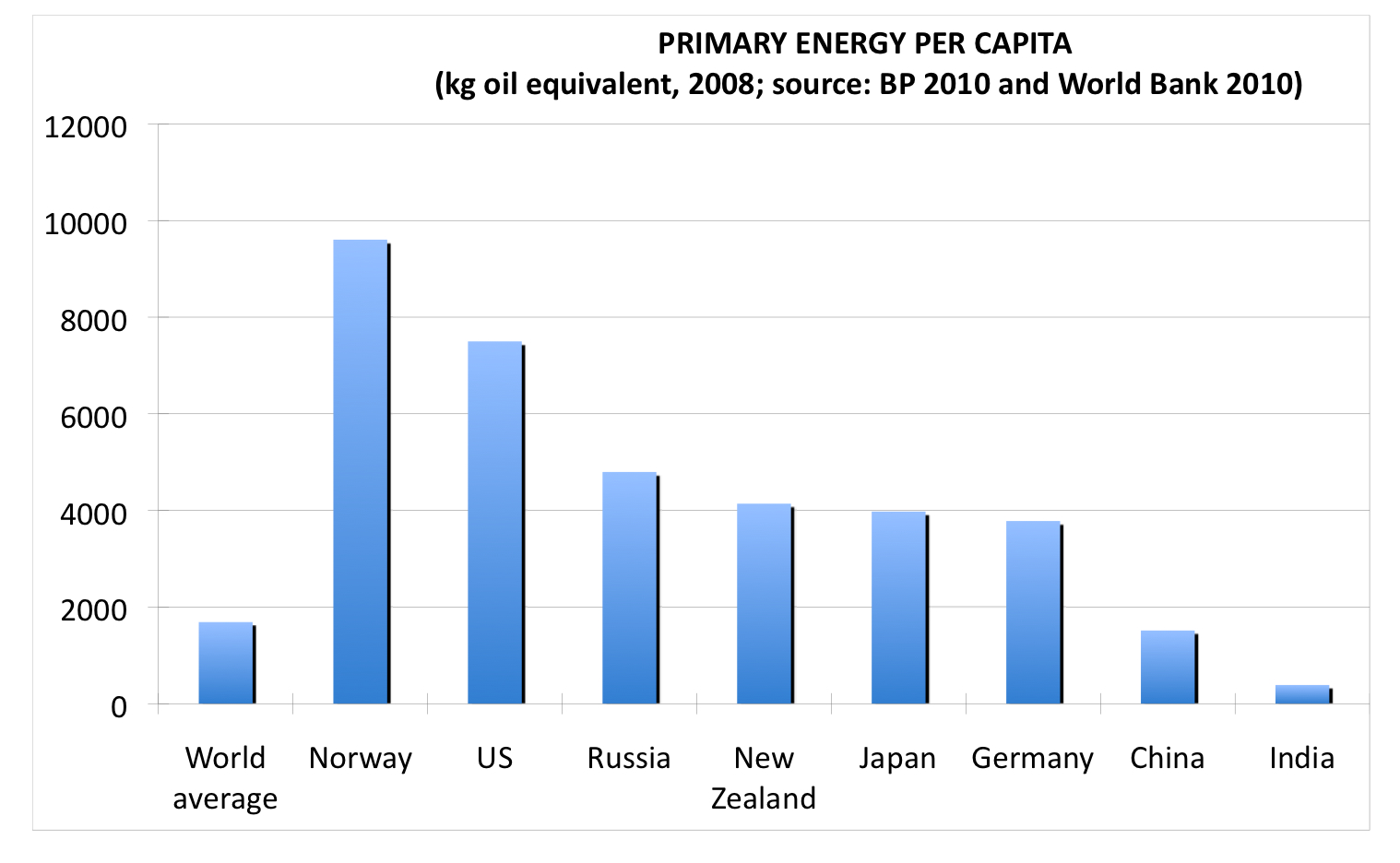
In the introductory lecture to my class on sustainable energy this semester our professor went through a bunch of graphs from the BP report on energy that show the distribution of energy use, CO2 emissions, and energy intensity across the globe. One thing about several of the graphs stuck me and I've put them below with a brief explanation.

Graph 1: Primary Energy per Capita


Note where India is on the graph. This is primarily due to their relatively small industrial base and extremely large population (the same reason that China, even with massive amounts of energy use, is small as well. Between the two of them they have somewhere between twenty-five and thirty-five percent of the global population). The next graph follows from this one and shows roughly what you'd expect.

Graph 2: Per Capita CO2 Emissions


As I said, this shows roughly what you'd expect. India has the smallest per capita energy use of the countries shown and thus has the smallest per capita CO2 emissions. As a side note, Norway drops off the graph because, while they use an enormous amount of energy, something like 90% of their electricity comes from hydro power, which for all its other environmental problems, is an extremely clean source of energy from a CO2 emissions standpoint.

The final graph is the kicker and what really caught my attention in class. It shows the per kilowatt hour emission of CO2. Basically how efficiently, from an emissions standpoint, you produce your electricity. As I've already said, Norway does this extremely efficiently.

Graph 3: CO2 Emissions per kW of Electricity


It should be obvious now that India does not produce electricity efficiently in terms of emissions. Nor does China (this most people knew already and is due to the massive number of coal power plants they are building). It's worth noting that Brazil, who also gets huge amounts of its electricity from hydro, is so low on the list and Norway isn't even on the list.

So what does it all mean? A lot of economists think that in the next 30 years India will overtake China as the fastest growing economy due to demographic reasons (China's population, due to the one child policy, has peaked and will start to decline. India, on the other hand, is still growing). Right now India's per capita emissions are so low because it's per capita energy use is so low, which is due to the fact that most of the population still lives an agrarian lifestyle. As Dani Rodrik points out here, as countries develop labor moves from agriculture to industry. Industry requires significant increases of energy inputs over pre-modern agriculture. A lot of this energy comes in the form of electricity (factory lights, urban street lights, factory machines, etc). Thus, as India's population urbanizes and industrializes their per capita use of energy, and therefore per capita emissions, will increase. What the third graph says is that for every unit increase in energy usage, their emissions will increase more than anywhere else in the world. So the least efficient country in the world in terms of emissions from electricity will also be the fastest growing country in the world. A wonderful combination.

Big picture? It means that global CO2 emissions will increase even faster as India industrializes than they did while China was industrializing. A terrifying thought for anyone who is concerned about atmospheric concentrations of CO2. It also underlines the absolute necessity of getting developing countries on board with any climate agreement. I'm not sure about the scale impacts of India's emissions relative to the developed world but it isn't inconceivable that their development could negate any unilateral efforts to reduce emissions undertaken by the developed world.

Thursday, September 16, 2010

Long term implications of the Oil Spill

The announcement that BP has successfully completed the static kill of the Macondo closes the first chapter of the story of the Deepwater Horizon disaster, the largest marine oil spill in history. Taken with the Obama Administration’s announcement that the majority of the oil in the Gulf has dissipated it would appear that the disaster is coming to a close. But, like the oil that has contaminated the Gulf for the last four months, appearances here are slippery. Although the oil is no longer spewing into the Gulf, the United States will be dealing with the environmental costs of this disaster for years to come.

The costs of this disaster are far from being completely calculated but are likely to run into the tens of billions of dollars. Many of these costs are obvious or easily predictable – the jobs lost due to the drilling moratorium, the lost tourist dollars as people fled the coast, the jobs lost in the fishing industry – but the most lasting costs may be to the environment. Anyone paying attention to the disaster has seen images of oil coated birds and heard stories of turtles burned alive. The media has focused on these images and the damages to coastal estuaries and wetlands as oil contaminated these incredibly fragile ecosystems. But it is the hidden effects on the breeding cycle of many of the marine animals that call the Gulf home that may, in the end, be the most damaging.


The explosion on the Deepwater Horizon could not have come at a worse time for the marine animals which spawn in the Gulf of Mexico. These animals return to the Gulf each spring to breed and release eggs into the water. This year they did this ageless ritual in heavily polluted and contaminated water that significantly reduces the likelihood of the new generations survival. Even in a normal year only a very small percentage of the eggs released grow to be mature fish. The oil and chemicals released to fight it this year could dramatically increase the mortality of the new generation. While the exact impact on the survival of this year’s spawning is unclear, experts fear that it could be devastating.


Many of these species are already dangerously threatened from over-fishing. Species like the blue-fin tuna are already at levels low enough to be considered threatened by the U.N. These species – along with the sword fish and yellow fin tuna – have long life-spans and correspondingly long sexual maturation. As a result, the destruction of an entire generation could have serious long term implications on the population as a whole.


The most similar historic example is the impact that hydropower installations had on salmon populations in the Pacific Northwest in the early 90s. Like many of the species in the Gulf, the salmon return to the same locations each year to spawn. The installation of hydropower facilities in many of these rivers prevented their return and, as a result, they did not spawn. This did not have an immediate impact. Instead, populations remained steady for several years but 4-5 years after the installation of the dams – the time when the first generations not to spawn because of the dams would have been maturing – the population crashed.


Why does this matter? Because if this happens in the Gulf it could have a devastating impact on the fishing industry in the region. Many of the species that return to the Gulf each year, the Yellowfin Tuna for example, are already struggling at dangerously low population levels. A significant drop-off in production in one year could have permanent long-term effects on the vitality of the population. If this were to happen the short term pain that the fishing industry is currently going through could become a much more permanent phenomenon.


The fishing industry is clambering for Obama to lift his ban on fishing in areas affected by the spill so that they can return to fishing. Precisely the opposite needs to happen. The ban should be continued until more information is available about the survival rate of this year’s spawning generation. To do otherwise risks permanently damaging one of the most productive fisheries in the world.


The exhaustion of dozens of other fisheries the world over proves that fishers struggle to manage these resources in the best of times. Too often the short term considerations of profit outweigh long term management considerations. Combined with a disaster like the Macando spill whose effects may not be fully felt for five years or more, this mindset could have terrible consequences for Gulf fishing. And if fishing in the Gulf collapses the economic pain the region will be just as harsh as the pain they are currently feeling but even more permanent.